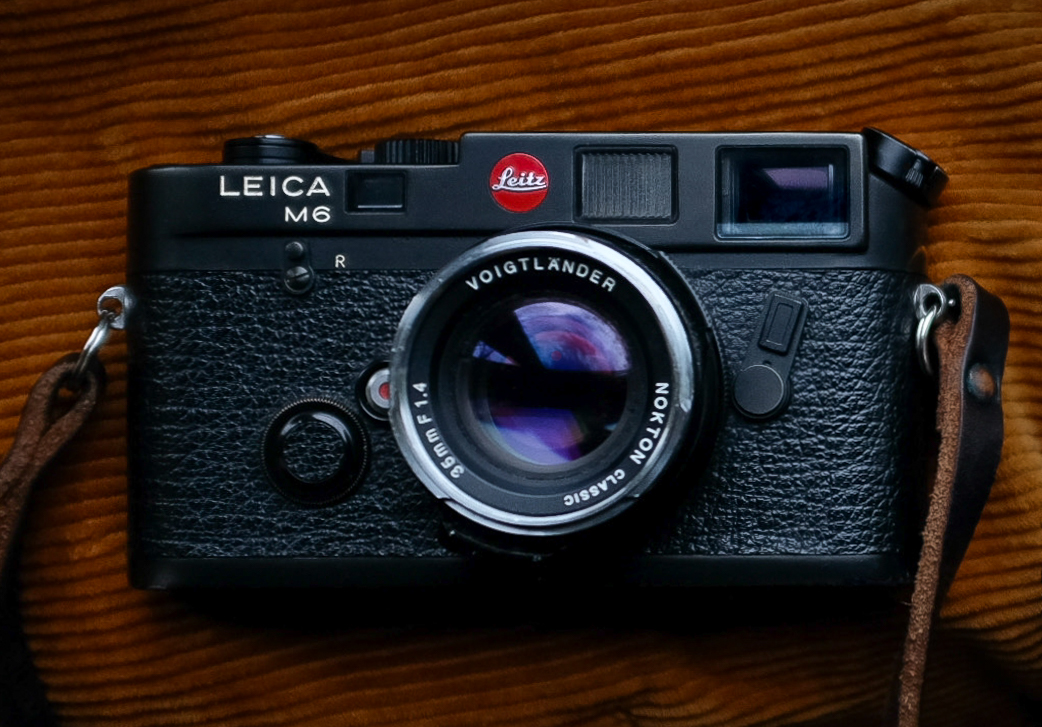
A classic M body for photographers who wanted a discreet meter without surrendering the mechanical rhythm of photography.

Leica M6 Classic: the rangefinder that kept the photographer in charge

Introduced in 1984, the M6 brought a selective meter into the compact, mechanical M tradition. It gave a photographer a quiet nudge in the finder, then left the choices of timing, focus and exposure in human hands. For street and documentary work, that balance mattered: the camera could be ready without demanding attention from the person holding it.

The initials “TTL” mean that the meter reads light through the taking lens; they do not mean TTL flash control on this Classic generation. That feature came with the M6 TTL in 1998, along with a larger shutter-speed dial and a slightly taller top plate. Keeping those generations distinct matters when looking at photos, buying a used body or reading its history.

Made in Germany, the M6 carried forward the long Leica M practice of bringing a compact rangefinder close to the photographer’s eye. Its story is less about automation than trust: a bright finder, a meter that assists rather than decides, and a mechanical camera that encourages you to slow down just enough to notice the light.

Black Leica M6 Classic with a Voigtländer Nokton 35 mm lens
Original file on Wikimedia Commons · license
Leica M6 Classic with Voigtländer Nokton 35 mm lensDrican26 · CC BY-SA 4.0

The shutter is a horizontal-travel, rubberized-cloth focal-plane design. Its speeds run from 1 second to 1/1000 second plus Bulb, with X flash synchronisation at 1/50 second. Because the shutter is mechanically timed, the camera can still expose and advance film when its meter batteries are exhausted; the cells power the meter, not the shutter.

Focusing remains entirely manual. The coupled rangefinder patch is combined with parallax-corrected bright-line frames. The standard 0.72× finder shows frame lines for common focal lengths, while the 1994 M6J anniversary edition and later special Classic bodies offered a 0.85× finder. The M6J was a limited 1,640-camera edition, not the M6 TTL: it belongs to the Classic generation.

The original body’s restrained exterior concealed a meaningful usability change: photographers could meter selectively without adding an external meter or changing the familiar M-series workflow. Leica describes nearly 175,000 M6 cameras produced from 1984 to 2002 across the Classic and TTL generations. That family total should not be mistaken for a production count of the 1984–1998 Classic alone.

Photographers behind the camera

The M6 became closely associated with documentary and street photography, where a quiet mechanical shutter, bright finder and compact body help a photographer work near a scene. Leica’s published project page documents Magnum photographer Bruce Gilden using an M6; its M6 overview also presents work and interviews tied to photographers including Paul Hepper, John Sypal and Joe Greer.

These references show the camera’s continuing use across very different approaches to photography. They do not imply that every image in a photographer’s wider portfolio was made with an M6.

Introduced 1984Format 35mmFocus Manual rangefinderMade Wetzlar / Solms, Germany

Technical specifications

Camera type35mm rangefinder camera
Release date1984
Dimensions138 × 77 × 38 mm
Weight560 g (body only, without lens)
Fixed lens / MountLeica M bayonet · interchangeable lenses
Film format35mm 135 · 24 × 36 mm
Sensor× · film camera
ISOManual film-speed setting: ISO 6–6400
ShutterMechanical horizontal cloth focal-plane shutter · 1 s–1/1000 s and B · X sync 1/50 s
Exposure systemSelective TTL metering at working aperture; manual exposure; no TTL flash metering
FocusingCoupled coincidence rangefinder · manual focus only
ViewfinderParallax-corrected bright-line finder · standard 0.72×; 0.85× M6J / special version
FlashNo built-in flash · hot shoe and PC sync · X sync 1/50 s · no TTL flash metering
BatteryMeter only: 2 × SR44/PX76 silver-oxide cells or 1 × DL1/3N lithium cell

Why photographers still choose the Classic

  • A discreet, compact camera that stays close to the photographer in crowded streets and quiet rooms.
  • Its meter offers reassurance while leaving the final exposure decision with the person making the picture.
  • A clear distinction between Classic and TTL generations makes the M6 story richer, not simpler.
  • Leica reports nearly 175,000 M6 family cameras produced from 1984 to 2002; the total includes Classic and TTL models.
Munich escalator photograph made with a Leica M6 by Markus Spiske

Photographs made with the Leica M6

Browse the Leica M6 group on Flickr ↗Preview: “Munich Escalator Underground” by Markus Spiske, licensed under CC BY 2.0.

Three M6 generations

Similar name, meaningful differences

1984–1998

M6 Classic

The original body: 0.72× standard finder, selective TTL exposure metering and a mechanical shutter. It does not meter flash TTL. The limited M6J and later 0.85× finder models are special Classic-era variants.

1998–2002

M6 TTL

The next generation added TTL flash metering, a larger shutter-speed dial and a slightly taller body. Finder magnifications included 0.72× and 0.85×, with 0.58× added later.

2022–present

M6 reissue

Leica brought the design back with brass top and bottom covers, updated finder coatings and a 0.72× viewfinder. It retains manual exposure and a mechanical shutter; its 575 g weight is specified without the battery. It is a modern reissue, not the original 1984 body.


Where it sits in the Leica M line

Related models

Predecessor · 1981Leica M4-PMechanical M body; the M6 adds a built-in meter.
Featured · 1984–1998Leica M6 Classic1984 original generation; TTL exposure meter, no TTL flash metering.
Next generation · 1998 / 2002M6 TTL → M7TTL flash metering from 1998; the M7 followed with electronic shutter control and aperture priority.
The original M6 Classic (1984–1998), M6 TTL (1998–2002) and 2022 reissue are separate generations. Leica’s nearly 175,000 production total refers to the M6 family through 2002, not to the Classic alone.
Compare this camera

Sources and image credits

Read the original references